
AI Workflow Automation: How It Works and Why It Matters
Introduction
As digital marketing continues to evolve at lightning speed, digital marketers in their 20s and 30s are under increasing pressure to deliver smarter, faster, and more data-driven campaigns. Embracing an AI workflow automation tool isn't just a passing trend - it's fast becoming a core necessity for modern marketers.
Over 80% of organizations are currently exploring ways to embed automation into their marketing processes (Deloitte, 2023). So, what's driving this shift, and how does artificial intelligence supercharge workflows to unlock new levels of productivity and insight? This article breaks down the mechanics, benefits, and best practices of AI-powered workflow automation - equipping you to stay ahead in your marketing career.
What is AI Workflow Automation?
AI workflow automation harnesses artificial intelligence to streamline, manage, and optimize complex marketing tasks - tasks that, until recently, required human effort. Unlike traditional automation that is limited to rigid, rule-based scripts, AI automation workflow introduces intelligence, adaptability, and the ability to learn from data.
For digital marketers, everyday examples of AI-powered workflow automation include:
- Segmenting audiences using unstructured data
- Predicting optimal send times for email campaigns
- Dynamically allocating budgets across channels
- Generating performance reports with natural language
A central pillar is the use of AI agents for workflow automation. These AI agents not only execute task sequences but also adapt to real-time feedback and autonomously interact with other software platforms (McKinsey & Company, 2022).
Integrating AI in workflow automation can fundamentally transform marketing operations - freeing up valuable time for strategy, creativity, and analytics.
Key Benefits of AI in Workflow Automation
Adopting AI-powered workflow automation provides digital marketers with dynamic, tangible advantages:
1. Efficiency and Productivity
AI automates repetitive, manual tasks - like data entry, scheduling social posts, and report generation - with speed and accuracy well beyond human capability (Statista, 2023). AI scheduling tools can save up to two hours per marketer each week - over 100 hours annually.
2. Cost Savings
Organizations using AI automation workflow tools often see operational costs drop by 20–30% within three years, thanks to higher accuracy, fewer errors, and faster task turnarounds (PwC, 2023).
3. Improved Insights
AI workflow automation tools process vast datasets instantly, uncovering trends, customer behaviors, and performance anomalies at a scope human analysts can't easily match (Harvard Business Review, 2021).
4. Personalization at Scale
Deliver customized content to thousands of users across multiple channels - instantly and effortlessly - with AI-powered workflow automation. What used to be a labor-intensive process is now automated and scalable.
5. Enhanced Agility
AI agent workflow automation responds in real time to shifts in performance metrics, user behavior, or market changes. Agile automation empowers marketers to pivot campaigns quickly and confidently.
How AI-Powered Workflow Automation Transforms Digital Marketing
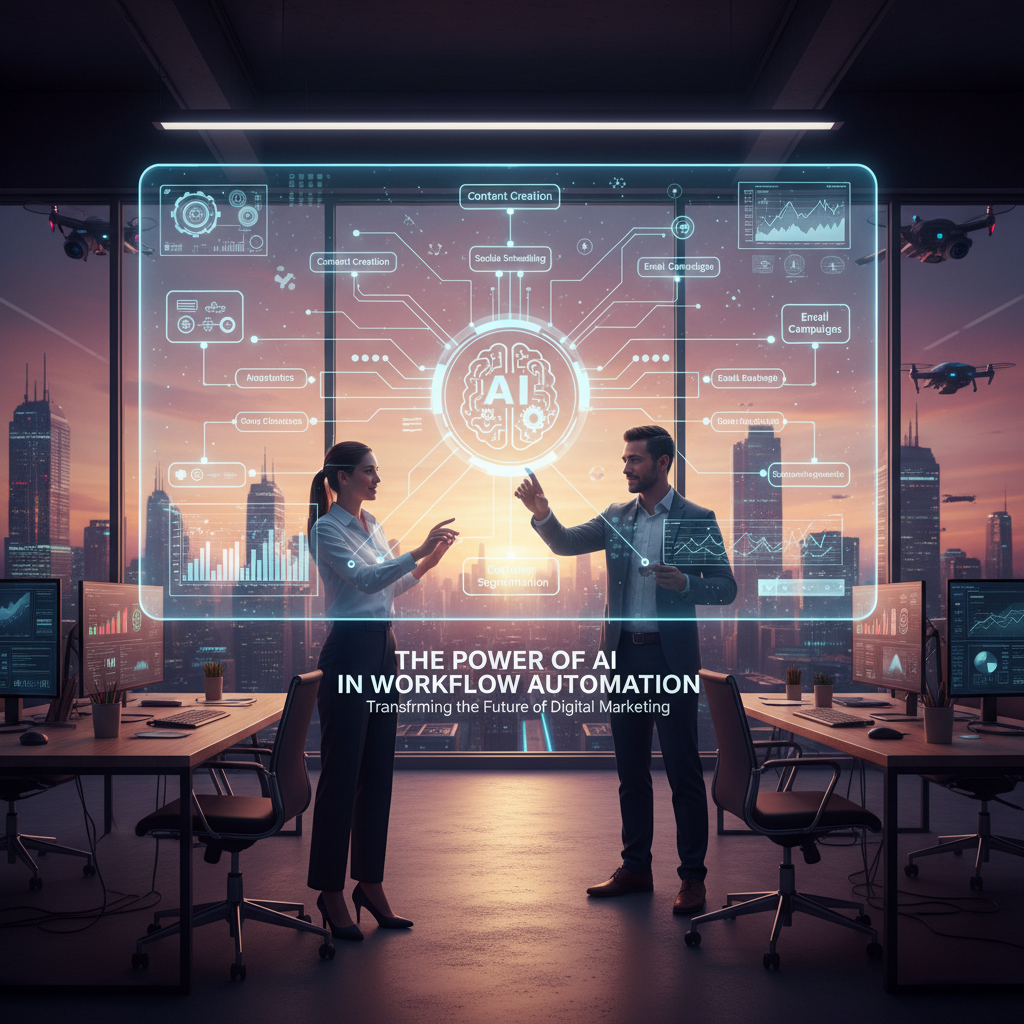
Here’s how AI-powered workflow automation is revolutionizing the workday of modern digital marketers:
Data-Driven Campaign Management
Launch campaigns where the AI tool actively monitors engagement, reallocating budget from underperforming channels to those that convert - without manual intervention.
Content Generation and Distribution
Natural language processing algorithms now generate audience-specific subject lines, ad copy, and social captions. Automated workflows post content at optimal times, maximizing reach and impact.
How to Maximize Free AI Content Generators for Better Content Creation
CRM and Lead Nurturing
AI agents for workflow automation score leads, assign follow-ups, segment lists, and ensure no potential customer slips through the cracks. Brands using AI in lead nurturing realize up to a 50% higher conversion rate on average (Salesforce, 2022).
Real-Time Analytics and Reporting
Manual reporting is out; instant AI-powered dashboards are in. Marketers receive automatic insights, optimization recommendations, and ROI forecasts - no waiting required.
Testing and Optimization
AI automation workflows set up, monitor, and analyze A/B and multivariate tests continuously - adapting campaigns to drive better results in real time.
AI Agent Workflow Automation: Breaking Down the Process
How exactly does an AI agent operate within a marketing workflow? Here’s a breakdown of the process:
1. Trigger
An eventl - ike a new form submission or a key user action - initiates the AI workflow.
2. Input Analysis
The AI workflow automation tool examines the incoming data, using natural language processing and predictive analytics to understand intent and urgency.
3. Decision Making
AI agents evaluate possible actions: Should the system segment a lead, launch a retargeting ad, or send a personalized email? By analyzing historical results, the agent selects the best course.
4. Execution
The agent performs the task - be it updating a CRM, posting on social, or delivering an email - fully autonomously.
5. Monitoring and Feedback
AI-powered workflow automation includes robust monitoring. If the results aren’t as expected, the agent adjusts future actions for better outcomes.
6. Learning Loop
With every workflow run, the AI agent becomes smarter - refining logic to improve future performance (Gartner, 2022).
Automate Workflows with AI: Practical Use Cases
From creative brainstorming to analytics, opportunities to automate workflows with AI are virtually limitless. Below are several use cases relevant to digital marketers:
Email Marketing
- AI-generated and personalized subject lines and content
- Automated send-time optimization
- Intelligent segmentation and list management
Social Media Management
- AI-powered content curation, scheduling, and posting
- Social listening and sentiment analysis at scale
- Automated responses to customer queries via AI chatbots
Paid Media
- Real-time bidding and budget allocation adjustments
- Automated creative asset testing (A/B/n testing)
- Predictive audience targeting for higher ROI
SEO & Content Marketing
- Automated keyword and topic research
- AI-generated briefs, outlines, and content suggestions
- Search intent optimization
Analytics & Reporting
- On-demand campaign dashboards
- Automated trend analysis and anomaly detection
- Predictive insights for KPI forecasting
By leveraging an AI automation workflow platform, marketers spend less time on manual tasks and more on creative and strategic initiatives.
Selecting the Right AI Workflow Automation Tool
With countless tools on the market, choosing the right AI workflow automation tool is critical. Here are key criteria to guide your selection:
1. Integration Capabilities
Does the tool effortlessly connect with your CRM, social platforms, ad networks, and analytics suite?
2. Customizability
Can you design custom workflows, or are you limited to basic templates?
3. AI Sophistication
Does the platform employ advanced machine learning, natural language processing, and predictive capabilities - or is it just basic automation under an AI label?
4. Scalability
Will the tool grow with your campaigns, supporting increasing data volume, users, and complexity?
5. User Experience
Is the interface intuitive, with drag-and-drop editors, visual workflow maps, and clear reporting - optimized for a generation of digital-first marketers?
6. Security and Compliance
Does the tool fully adhere to privacy regulations and data security standards?
Evaluate these aspects to ensure your investment in AI-powered workflow automation pays off with maximum ROI and peace of mind.
Challenges and Considerations
While AI agents for workflow automation provide immense value, they also come with unique challenges:
Data Quality
AI effectiveness hinges on the quality of input data. Flawed or incomplete data can drive misguided automation outcomes (IBM, 2022).
Over-Automation
Relying too heavily on AI can risk customer interactions feeling impersonal or robotic. Balance is crucial- keep the human touch where it matters most.
Change Management
Moving to AI-powered workflow automation requires planning, team buy-in, and ongoing training for your marketing staff.
Ethical Implications
Using AI to process and act on customer data brings privacy and transparency responsibilities. Navigating regulations like GDPR and upholding ethical standards is non-negotiable.
Cost and Complexity
Advanced AI workflow automation tools require up-front investment - in both software and training.
By anticipating these challenges, you can unlock the benefits of AI in workflow automation while minimizing risk.
The Future: What’s Ahead for AI Agents in Workflow Automation
The future of AI agent workflow automation in digital marketing is set to accelerate. Watch for these game-changing trends:
Hyper-Personalization
AI agents will tailor website content, email offers, and brand messaging for every individual user in real time (Accenture, 2023).
No-Code/Low-Code AI
Visual editors and drag-and-drop builders will empower marketers of any background to deploy advanced automation - no coding needed.
Autonomous Campaigns
AI agents will manage campaign lifecycles proactively, from ideation to execution and optimization, freeing marketers to focus on high-level strategy.
Enhanced Collaboration
Cloud-based AI workflow automation tools will enable seamless teamwork between humans and AI, integrating automation throughout marketing functions.
Ethical, Explainable AI
Transparency and explainability in AI decisions will become standard, ensuring trust and understanding for both marketers and end-users.
These developments will further amplify productivity and creativity for digital marketers prepared to embrace the future of automation.
Conclusion
AI is redefining workflow automation for digital marketers - enabling the automation, personalization, and optimization of tasks at unprecedented scale. By adopting the right AI workflow automation tool* and following best practices for integration, customization, and ethical deployment, marketers can maximize time, reduce costs, gain deeper insights, and stay at the leading edge of digital marketing innovation.
Stay informed and agile with the latest in AI-powered workflow automation - and prepare for the next wave of change in your marketing career.
Build Your AI Tools in Creator Hub Today
Ready to automate your next campaign, streamline your reporting, or personalize every touchpoint? Build your AI tools in Creator Hub today and unlock a new era of efficiency and innovation in your marketing workflows.
Build Your AI Tools in Creator Hub Today
References
Accenture. (2023). Personalization Pulse Check: The state of personalization in marketing. Retrieved from https://www.accenture.com/
Deloitte. (2023). Global Marketing Trends. Retrieved from https://www2.deloitte.com/
Gartner. (2022). Market Guide for Artificial Intelligence in Marketing. Retrieved from https://www.gartner.com/en/documents/
Harvard Business Review. (2021). How Marketers Can Make Smarter Use of Data. Retrieved from https://hbr.org/
IBM. (2022). The Business Value of Artificial Intelligence. Retrieved from https://www.ibm.com/
McKinsey & Company. (2022). The state of AI in 2022 - and a half decade in review. Retrieved from https://www.mckinsey.com/
PwC. (2023). AI Predictions. Retrieved from https://www.pwc.com/
Salesforce. (2022). State of Marketing Report. Retrieved from https://www.salesforce.com/
Statista. (2023). Time saved through automation in marketing by task in the U.S. 2023. Retrieved from https://www.statista.com/

About Nguyen Thuy Nguyen
Part-time sociology, fulltime tech enthusiast